
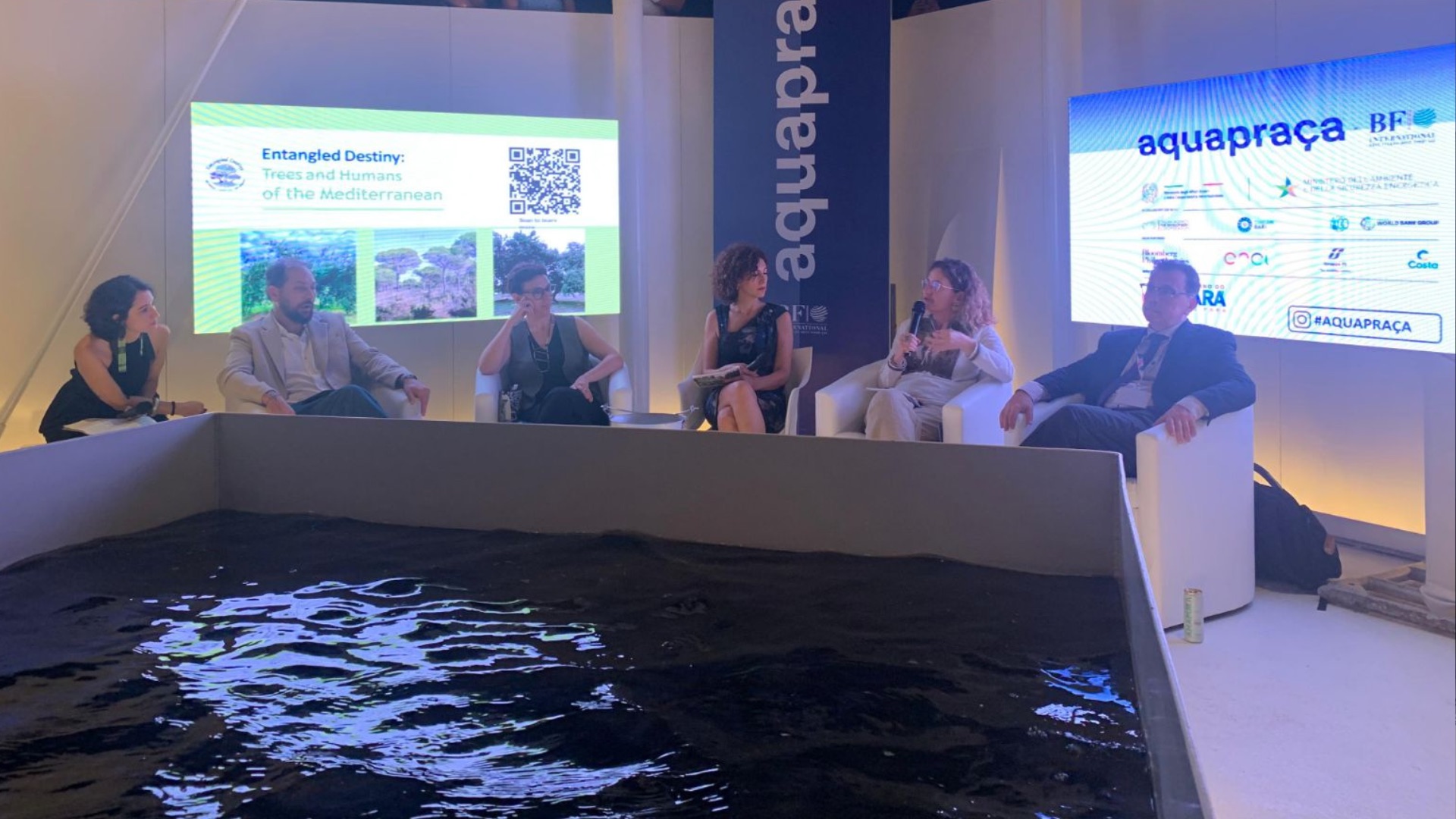
On 15 November at COP30 in Belém, Brazil, the side event “Entangled Destiny: Trees and Humans of the Mediterranean” examined the intertwined cultural and ecological resilience of Mediterranean landscapes, highlighting the deep and enduring relationships between people and trees. The discussion shed light on how these connections shape livelihoods, identities, and the biocultural heritage of Italy and the wider Mediterranean region.
As part of the Italian Pavilion’s programme at the AcquaPraça, the event showcased how Italy’s biocultural landscapes embody resilience, innovation, and cooperation, i.e., principles that underpin global climate action. The session began with an interactive activity in which participants shared personal experiences and emotional connections with nature, encouraging individual reflection and collective storytelling. These insights prepared the ground for a panel discussion where experts explored how human–tree relationships can inform sustainable land management, biodiversity conservation, climate adaptation strategies, and heritage preservation. Speakers emphasised the importance of safeguarding cultural and ecological heritage amid changing land-use patterns, technological evolution, and globalisation, through strategic management, community involvement, and adaptive reuse.
Among the speakers who took part in the discussion, FERS Director Giulia Galluccio, contributed with a perspective centred on the role of cultural and natural heritage as powerful connectors between people, landscapes, and climate resilience. It has been highlighted how addressing climate change requires bridging scientific research with cultural identity, traditional knowledge, and community memory, making climate action more meaningful and more inclusive.
Three key messages were shared during the event:
- Trees are cultural heritage agents that have shaped Mediterranean landscapes, economies, and spiritual traditions.
- People and ecosystems share a common fate: the health of Mediterranean ecosystems and livelihoods is closely interconnected, and revitalising tree-based systems is essential for climate resilience and food security.
- Nature-based solutions must be grounded in traditional ecological knowledge, particularly the agroforestry and land-use systems that have defined Mediterranean landscapes for centuries.
In addition, it was underlined the importance of training and education, intended as a transformative driver for cultural safeguarding and climate resilience, as well as s strengthening factor for long-term cultural heritage preservation. FERS Director Giulia Galluccio highlighted that “Building climate resilience passes through accessing information and data: people need to have knowledge to feel empowered.” Training and Education are essential for transforming knowledge into action and passing it on to younger generations, ultimately fostering a community of scientists capable of shaping their own local contexts. In this sense, creating climate literacy is fundamental to building resilient communities.
The Future Earth Research School courses focus, among other themes, on Heritage and the Creative Arts. The School was established to provide interdisciplinary training also at the intersection of environmental science and cultural heritage. Information on forthcoming courses and initiatives related to Heritage and the Creative Arts will be shared soon.