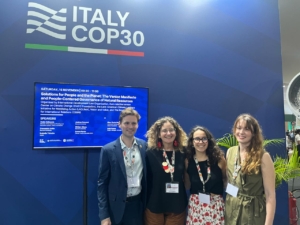

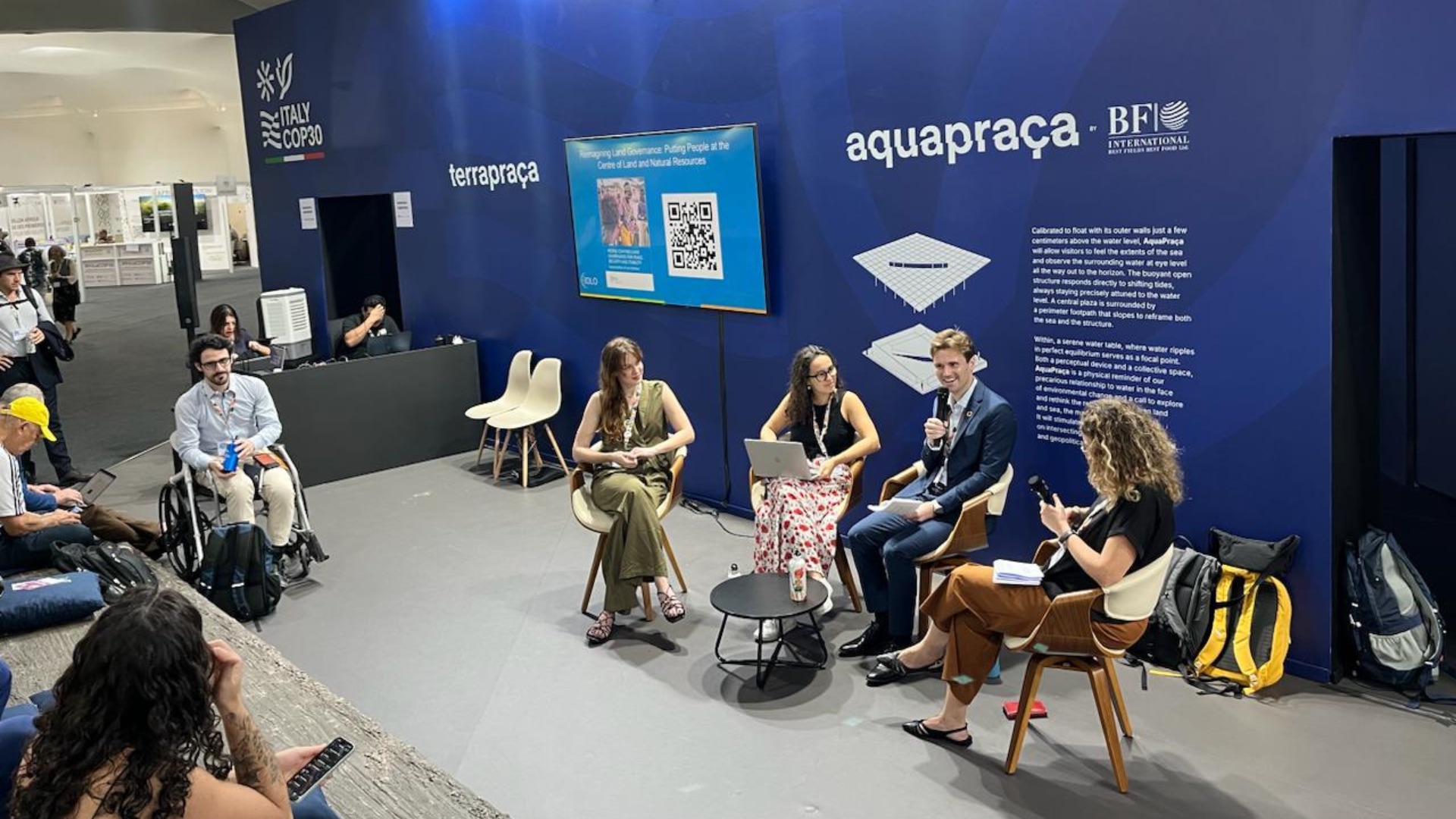
On 15 November at COP30 in Belém, Brazil, the event “Solutions for People and the Planet: Reimagining Land Governance – Putting People at the Centre of Land and Natural Resources” explored how to transform land governance models into more inclusive and sustainable systems. Speakers examined how legal tools can reduce inequalities, strengthen environmental stewardship, and build more resilient societies by aligning rights, responsibilities, and natural resource management.
Our Director Giulia Galluccio chaired the session at the Italian Pavilion, which was co-organised by the International Development Law Organization (IDLO, Italy), the Euro-Mediterranean Center on Climate Change (CMCC Foundation, Italy), and the Latin American Climate Lawyers Initiative for Climate Action (LACLIMA, Brazil).
Daniel Eggleston presented insights from a multi-country analysis of IDLO’s experience, demonstrating the importance of rule-of-law interventions — including legal education, legal aid, and community mobilization — in enhancing people’s understanding of the law and awareness of their rights. He highlighted the value of combining legal pluralism with engagement of customary and informal justice providers to expand access to justice and peacefully resolve disputes in Africa’s most climate-vulnerable regions.
FERS alumna Elisa Fiorini Beckhauser introduced European policy and governance frameworks for coastal adaptation, highlighting challenges such as defining coastal communities, mismatches between climate impact timescales and existing planning laws, and uneven progress of adaptation policy frameworks among European countries. She emphasised the need for robust legal frameworks to mediate competing interests and to guarantee transparency, participation, and access to justice in adaptation-related decision-making.
She also presented key findings from the Sea Legal Rise project, identifying NGOs, individuals, and local authorities as the main plaintiffs in coastal climate litigation, with national governments and fossil fuel companies most frequently acting as defendants. She noted the three main legal discussion of these cases, including government accountability for inconsistencies between international commitments and domestic legislation, corporate responsibility for greenhouse gas emissions, and the impacts of infrastructure projects on coastal ecosystems and communities. A major challenge identified by the project is the gap between legal practice and climate science, as legal practitioners often struggle to translate complex scientific data into evidence that meets judicial standards.
Gaia Hasse discussed Brazil’s updated National Adaptation Plan as a flagship example of participatory climate governance in the Global South. She stressed the importance of engaging civil society networks, LCIPP organisations, and scientists in defining adaptation priorities, showing how this process introduces social vulnerability narratives and explicit climate justice language across sectors. Drawing on insights from participatory planning, community-based strategies in climate-affected regions, and access-to-justice experiences, her presentation offered lessons for scaling inclusive adaptation and bridging the science–policy–justice gap across Latin America.
The event concluded by underlining an important central message of the event. It was emphasized the urgent need to bridge climate science and legal practice.
For those looking to engage further on this topic, we recommend the upcoming FERS Summer School on CLIMATE CHANGE LAW & SCIENCE: exploring the interplay between legal systems and climate change science. The course will be held at Villa Vigoni in the week July 20-25. It will directly address this challenge by building the interdisciplinary capacity of researchers and practitioners to navigate and connect the languages of science and law.